Resource sectionThought Leadership
Why Are We Giving Agents Cave Paintings?
Imagine archaeologists of the future trying to understand how we work by studying Word docs, screenshots, and standard operating procedures. They’d think our work was really boring. That we never had any fun figuring things out.
We understand what came before us by studying artifacts: what was written down or painted or built. But many of our first impressions prove to be dead wrong. That’s because we tend to rely on incomplete records.
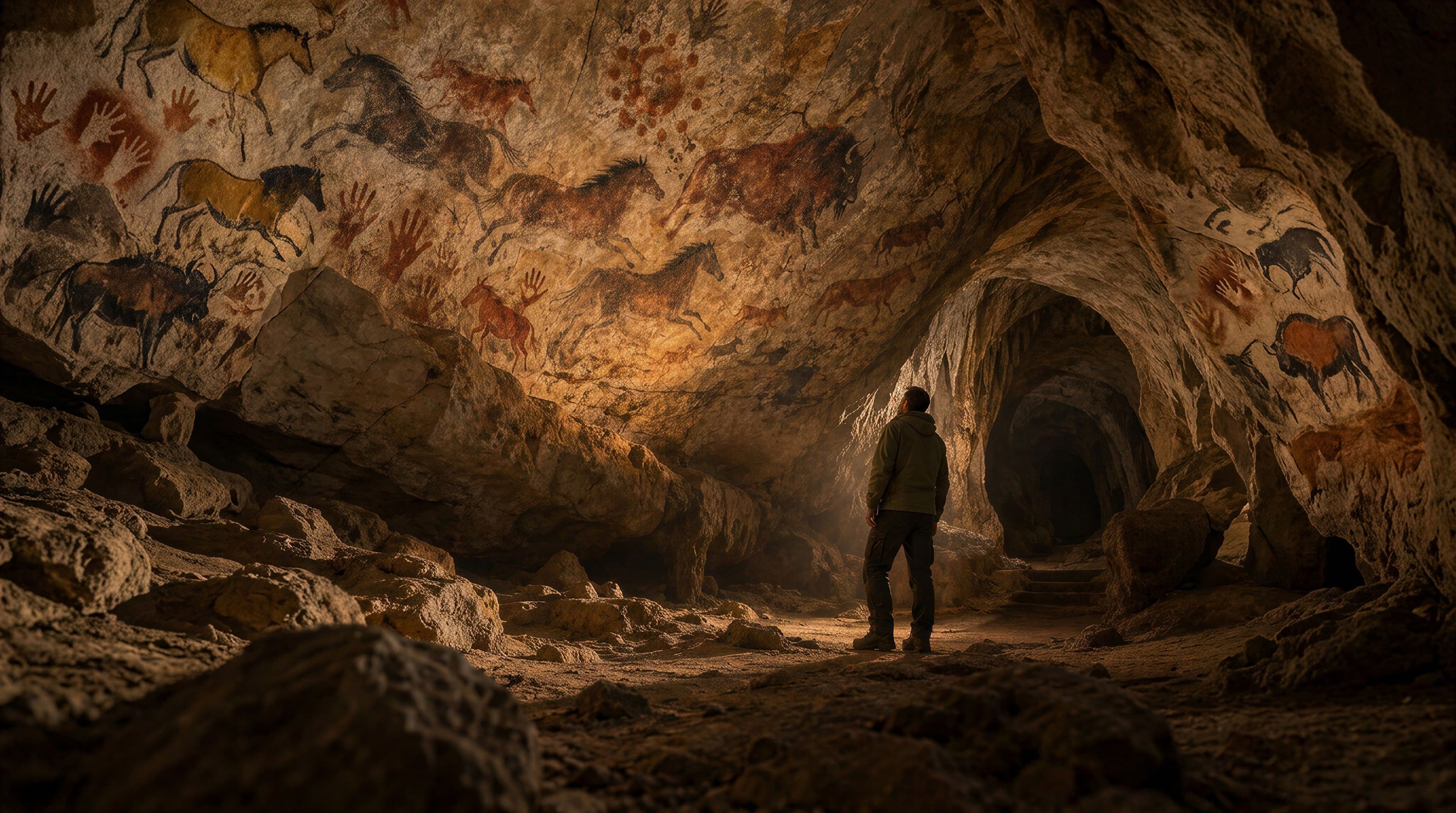
The people who painted the Lascaux caves, for example, mostly ate reindeer. We know this because archaeologists found more reindeer bones buried in the floor than any other animal. But on the walls, the people of southwestern France painted hundreds of horses, aurochs, stags, and bison. They only painted a reindeer once.
If you tried to reconstruct daily life 17,000 years ago from those cave paintings alone, you would get the diet wrong. You would know nothing about how tall they stood or how worn down their teeth were. The only human figure at Lascaux is a stick figure lying near a wounded bison. They weren’t very good at self-portraits.
I keep coming back to that cave, because most attempts to understand how a company works start from the modern equivalent of cave paintings.
There are two common approaches to understanding work today. From our research, neither captures the current state well enough to set companies up for the future of work, some of which will be automated by agents.
1. The Documentation Approach
The first approach to understanding work is to study documentation: the SOPs, the process maps, the onboarding decks. SOPs typically show the happy path and don't necessarily reflect reality: all the variations, permutations, workarounds. Somebody has to take this on as an extracurricular — it's not anyone's full-time job — so it’s always woefully incomplete.
2. The Systems Approach
The other approach starts from systems. Connect to the ERP, the CRM and the ticketing tool, and mine the event logs. This is more rigorous, but it is still a cave painting, because a system records only what it was built to record.
Our research across 120 customers proves this out. More than half (47%) of work happens outside a system of record, ending up in Excel sheets, notepads, and so on.
To add to the problem, while the average workflow in an enterprise uses four systems, one value chain (e.g. order to cash, procure to pay) uses a whopping 17.8 systems. And that footprint covers only the 52.9% of work that happens inside a system of record at all.
We wanted to understand how much work lives in that SOP + Systems record gap. Here are a few data points from our research.
What Your Agent Misses if You Only Feed it Logs from SOPs and Systems
Across 79 customer companies, Within has turned captured work into more than 30,000 process definitions containing about 924,000 individual steps. We tagged every step by where it happens.
- At the median company, 47% of documented steps happen in general-purpose applications: spreadsheets, email, documents, chat, meetings.
- Forty-three percent happen in structured systems like ERP, CRM and HR platforms.
- The remainder either straddle both, like copying numbers from a spreadsheet into Salesforce, or couldn't be classified.
- Microsoft Excel appears in the documented work of 78 of our 79 customers. At the average customer it shows up in about a quarter of all steps. That is more than Salesforce, SAP, Oracle, NetSuite, Workday and ServiceNow combined.
- Finance is the function most people would assume has been fully systematized. It runs on the ERP, it gets audited, it closes on a calendar. But again, at the median company in our data, more than half of finance work (47%) happens in general-purpose applications.
- One customer does about 9 percent of its documented work in applications, another nearly 87 percent. That’s a huge spread, but there’s one commonality: none of them can see all of their work by looking at their systems.
Why agents keep failing
Every company I talk to wants to deploy agents to achieve their business goals, and most of them are building those agents from cave paintings.
They hand the agent the SOP, or connect it to the systems of record, and then teams start to abandon it because it’s not good at its job.
This matters more now that the industry has a name for what agents need — context, or what we call a Work Brain that captures every step of how work actually gets done and how decisions get made inside a company. That Brain is only as good as what you feed it. Build it from systems of record and you get a very detailed map of the horses and zero reindeer.
One of the questions our team asks buyers is what an agent might miss if they only looked at company documentation or systems. That’s an interesting question because it helps enterprises determine their own readiness for agentic work.
What We’ve Learned From Anthropology
Archaeologists need more than cave paintings to understand ancient societies. Early anthropologists had a similar challenge. Much early learning about other cultures was done from interviewing people and reading what administrators had written down.
But when you set up a tent inside a village and live with a community, you understand things from the inside. You observe the tiniest interactions and rituals — the stuff of daily life. That’s called fieldwork, and it became the standard because people’s own accounts of their lives left important things out.
Within is built on the same premise. It observes work as it happens, across every application a person touches, and reconstructs the process from what it saw: the steps, the handoffs, the waits, the exceptions, the workarounds and the judgment calls that decide how a job gets done. Then it converts that into a Work Brain that has context for whatever agent platform the company already runs.
If you are planning to deploy agents next year, a good first step is to do some honest accounting of how well you understand the work you want to automate. Does your company’s routine work actually touch the system you plan to connect the agents to? Or does it mostly live in people’s heads?
At the median company we studied, under half had systems with enough context to set agents up for success. Much of what their agents needed to succeed never made it onto the cave wall.